 Get VnExpress first in Google Search
 See more of the news you trust. Make VnExpress a preferred source to prioritise our updates in your Google search results
As the tide peaked on Thursday afternoon, 80-year-old Nguyen Thi Lanh stood outside her house in an alley off Tran Xuan Soan Street in Tan Hung Ward, formerly District 7, relieved to find it still dry.
Locals in the flood-prone area have long used a saying for the high water that follows the full moon: on the 17th, the water leaps its banks.
This year, the 17th day of the 10th lunar month fell on Wednesday. The river rose high, but homes and alleyways stayed dry because the tidal sluice gates were operating.
Lanh moved to the area along the Te Canal with her family when she was 18, when the surroundings were mostly vacant land and rice paddies.
Over time, houses sprang up close together and narrowed the natural drainage routes. Sewers in the small alleys, often clogged with trash, made the water rise high and drain slowly.
Tides began flooding the entrance to her home before 2000, she said, and the water kept rising even though the alley was raised several times. Her family raised the floor of their house three times, to half a meter above the street, yet water still got in at times.
Tidal peaks at the Phu An station in the former central District 1 and at the Nha Be station rose by an average of 31-38 cm over the 25 years from 2000 to 2025, according to the Southern Regional Hydro-Meteorological Center.
"Some nights, snakes came in with the water through the gaps in the door and crawled onto my daughter, and the whole family couldn't sleep," Lanh said.
Water surging up from the drains brought a foul smell. Her walls are damp and moldy with peeling paint, and the legs of her fridge, her washing machine and an iron staircase have rusted after repeated soaking.
To keep the water out, many households around Lanh's home raised their floors, built low brick walls or fitted wooden or aluminum boards across their doors. When the water topped those barriers, they stacked sandbags and pumped it out.
The tides also hit livelihoods. Huynh Van Dang, 36, who has run a chicken rice shop on Bui Van Ba Street in Tan Thuan Ward for two years, has often lost customers when water from the street poured into his shop.
He had picked the spot because it was near a market, busy and rarely flooded. But high tides late last year and this year sent water into the shop, at times more than 30 cm deep.
On evenings when the street and shop were awash and customers stayed away, he livestreamed the flooding on a TikTok channel he set up to kill time. A three-hour livestream on Oct. 12 drew tens of thousands of views, and many sympathetic viewers later came to eat at his shop to support him.
On Wednesday, with the sluice gates operating together, Dang saw the street outside his shop stay dry, unlike during earlier tides.
"I'll keep watching the coming high tides, and if the flooding is over, I'll renovate the shop and add dishes to expand the business," he said.
Huynh Van Dang livestreams the high-tide flooding that kept customers away from his chicken rice shop, in a clip sped up from three hours of rising water on Oct. 12, 2026. Video courtesy of Huynh Van Dang
Southern Ho Chi Minh City, which covers the former districts 7, 8 Binh Chanh and Nha Be, is usually hit by high tides from the ninth to the 12th lunar month.
The water rises at the start and middle of each lunar month, and each spell lasts three to four days, flooding many streets and neighborhoods along rivers and canals.
On Wednesday afternoon, the first day the gates operated together, the tide peaked at 1.65 m at the Phu An station on the Saigon River, 5 cm above alarm level 3, the highest alert, and at 1.66 m at the Nha Be station, the Southern Regional Hydro-Meteorological Center said.
That level is 13 cm below the record of 1.78 m set at Phu An in November 2025, but it used to flood streets such as Tran Xuan Soan and Pham Huu Lau. This time, many roads that usually go under, including Huynh Tan Phat, Nguyen Binh, Le Van Luong and National Highway 1, stayed dry.
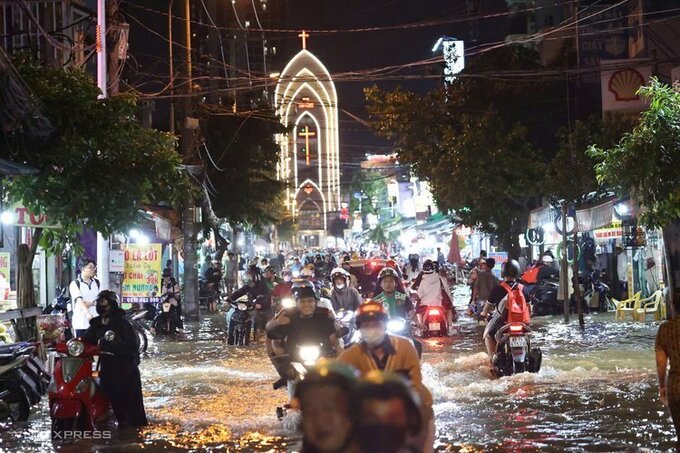
The dry streets are the first results of the sluice gates of the VND10 trillion (US$387 million) flood control project operating as one system.
The system comprises six major tidal sluice gates, ranging from 40 to 160 m wide, and two smaller ones, 10-25 m wide.
It is designed to control tidal flooding across about 570 sq.km, more than a quarter of the city's pre-merger area, benefiting about 6.5 million people.
During Wednesday's trial run, water levels on either side of the gates differed by 1-2.05 m, showing the system was keeping water from the major rivers out of the protected zone, according to the city's Department of Agriculture and Environment.
Some streets beneath Phu My Bridge, such as Dao Tri, Go O Moi and Nguyen Van Quy in Phu Thuan Ward, were still affected by rising water.
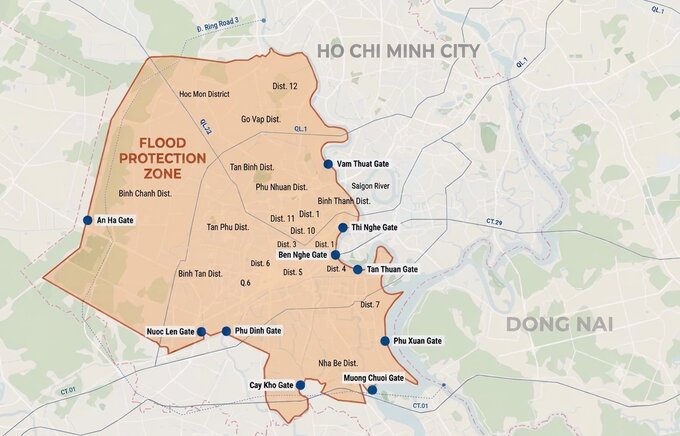 |
| Ho Chi Minh City's tidal control project covers 19 former urban districts across about 570 sq.km, benefitting about 6.5 million people. Graphic by VnExpress/Tam Thao |
The operator said the system does not yet fully enclose the protected zone. At some open stretches outside the project's scope, water from rivers and canals can still get in even with the gates closed.
In July, the Department of Agriculture and Environment proposed investing early in 19 more dikes, embankments and sluice gates to close off the protected zone.
Besides blocking tides, the project's gates, dikes and embankments keep canal water levels low, creating room to hold rainwater from the urban drainage system.
When heavy rain coincides with a high tide, the system can drain water one way from the canals inside the protected zone out to the rivers, stopping it from flowing back into the city.
Three pumping stations at the Ben Nghe, Tan Thuan and Phu Dinh gates, with a combined capacity of about 120 cubic meters per second, run when needed to keep canal levels inside the zone no higher than 1.2 m.
The system still has to prove itself in higher tides, especially when they coincide with heavy rain. On Friday night, the investor said it would keep the gates closed overnight until the next morning for the first time, to hold back the rivers through two consecutive high tides as unseasonal rain hit the city.
The city's largest tidal flood control project broke ground in 2016 and has been delayed three times. Throughout the decade since, Lanh has waited for the day she no longer has to scramble to keep the water out whenever the river rises.
"My children and grandchildren live near me now, so I always hope they won't have to put up with floods the way I have for decades," she said.


