Get VnExpress first in Google Search
  See more of the news you trust. Make VnExpress a preferred source to prioritise our updates in your Google search results
In 1899, Governor-General of Indochina Paul Doumer ordered the construction of Hanoi's tram network, following Saigon's. Around September 1900, the first tram ran a test service on the Bo Ho-Lang Giay (Thuy Khue) line. By November 1901, the line had been extended to Buoi Market and entered service. Once complete, the network comprised five lines: Bo Ho-Buoi, Bo Ho-Ha Dong, Bo Ho-Cho Mo, Bo Ho-Cau Giay and Yen Phu-Vong.
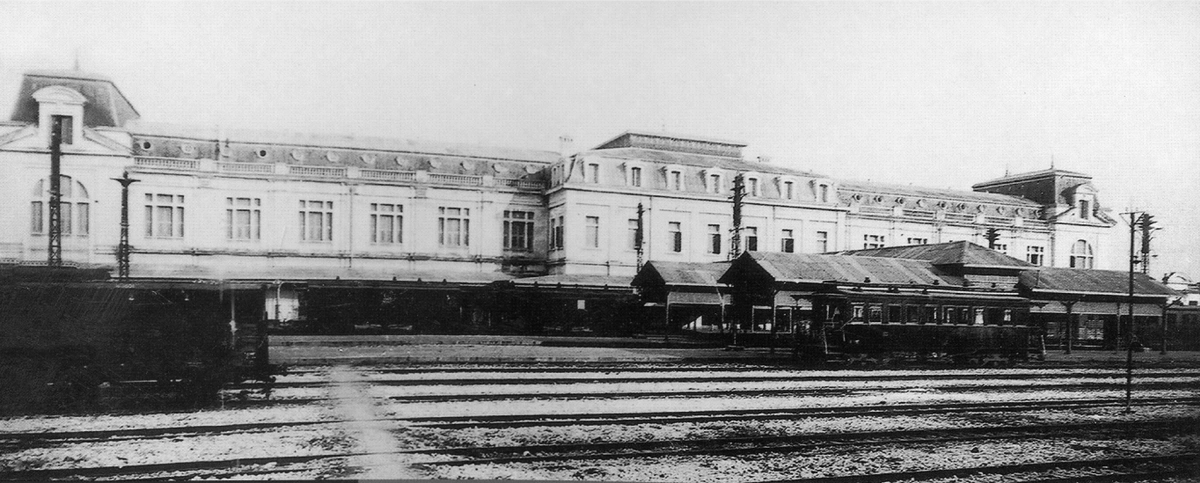
Hanoi Station, also known as Hang Co Station, opened in 1902 and was once among the largest railway stations in Southeast Asia. It was built as the French administration developed rail lines across Indochina.
The station was initially the starting point of the Hanoi-Lang Son railway, joined by the Hanoi-Hai Phong line in 1903. In 1905 a line to Lao Cai was established. By 1939, Hanoi Station had become the junction of the trans-Vietnam railway.


Before 1884, Hanoi had no public transport. Residents mostly walked or rode ox carts, while mandarins traveled by hammock or palanquin. Horse-drawn carriages appeared in 1885 as the city's first public transport, mainly carrying French residents from the Don Thuy concession into the center via Trang Tien and Trang Thi.
In 1940, American photographer Harrison Forman documented Hanoi under French rule, capturing bicycles and rickshaws crowding the streets. His images of the Cua Nam flower garden and Hang Bong and Hang Khay streets show what transport and urban life looked like more than 80 years ago.
Rickshaws and cyclos on Trang Tien Street, then Paul Bert Street, outside the Eden Cinema, now the Cong Nhan Theater. Photo by Harrison Forman
The intersection at Trang Tien Plaza, then the Grands Magasins Reunis department store, was the busiest in the city in the 1940s, drawing every mode of public transport of the era. Photo by Harrison Forman
At Ben Nua, near the foot of Long Bien Bridge in what is now the Tran Nhat Duat-Yen Phu area, three filling stations run by Shell, Texaco and Socony stood in a row. Coaches refueled here before carrying passengers to provinces including Hai Phong, Bac Ninh, Phu Lang Thuong, Lang Son, Cao Bang, Tuyen Quang, Bac Giang, Tam Dao and Viet Tri.
Intercity services at Ben Nua were posted with their destinations and the road distance from Hanoi. Before it, Cot Dong Ho, the Clock Tower, served as the city's first passenger terminal. Hanoi added the Cua Nam and Kim Ma terminals in the 1920s. Photo taken in 1940-1941 by Harrison Forman
Vietnam's civil aviation industry began in January 1956, when the government established the Civil Aviation Department. The northern civil fleet at the time consisted of aircraft registered VN-198, VN-199, VN-200, VN-201 and VN-202.
On Sept. 2, 1956, the first domestic route, Hanoi-Vinh-Dong Hoi, was inaugurated at a fare of VND30 in northern currency.
Pictured is Gia Lam Airport in 1959 with Soviet-built aircraft. Photo courtesy of Flight Squadron 919
Da Phuc military airfield in 1967. Archive photo
In the early 1960s the state decided to build the airfield in what was then Kim Anh District, now part of Noi Bai Commune. In April 1966, Soviet military advisers arrived at Da Phuc to train Vietnamese pilots and aviation technicians.
A trolleybus at Dong Kinh Nghia Thuc Square beside Hoan Kiem Lake. Two parallel poles on its roof connected to a pair of DC overhead wires through grooved copper rollers.
The tram rails were torn up in 1988 and replaced with trolleybuses. The new vehicles proved inefficient, however, as they had no dedicated lane and disrupted other traffic. Hanoi's electric tram service ended in 1991 after nearly a century. Photo by Jennifer Lynas
A corner of Kim Ma bus terminal in 1996. By the 1990s Hanoi was running buses on routes including Yen Phu-Ha Dong, Bac Co-Ha Dong and Giap Bat-Hang Co Station-Gia Lam. Photo by Jennifer Lynas
Hanoi now has more than 8 million private vehicles, including roughly 1.1 million cars and 6.9 million motorbikes. The area inside Ring Road 1 alone accounts for more than 450,000 motorbikes, leaving many streets congested for long stretches of the day.
Hanoi Bus Enterprise, which began as Thong Nhat Passenger Transport Company, has operated since the 1960s and now runs 13 routes with 179 buses and more than 800 staff. In June 2026, Hanoi Transport Corporation, or Transerco, put 281 electric buses into service across 17 routes.
Pictured, buses queue among motorbikes on Nguyen Trai Street near Nga Tu So. Photo by Ngoc Thanh


Hanoi BRT Enterprise, a Transerco unit, began operating in December 2016. It was assigned bus route No. 2 between Bac Co and Yen Nghia Bus Station, then launched BRT01 from Yen Nghia Bus Station to Kim Ma on Dec. 31, 2016, the first bus rapid transit route in Hanoi and in Vietnam.
BRT services run in a dedicated lane with enclosed shelters and level boarding, which speeds up loading and shortens journey times. Transerco has since operated more than 3 million bus trips carrying over 200 million passengers. Photo by Giang Huy


The Cat Linh-Ha Dong metro, or Line 2A, was the first elevated railway in Hanoi and in Vietnam, running 13.05 km across 12 stations from Cat Linh to Yen Nghia.
An end-to-end trip takes just over 23 minutes. On weekdays the line carries between 22,000 and 35,000 passengers, and it has served nearly 53 million since commercial operations began. Photos by Pham Chieu, Ngoc Thanh


On Feb. 28, 1977, the General Department of Civil Aviation renamed Da Phuc military airfield as Noi Bai International Airport. Less than a year later, on Jan. 2, 1978, it handled its first commercial flight, completing the shift from a strategic military base to the main air gateway for the capital and the country. Photos by Giang Huy, Thanh Hai